

Table of Contents
The iPhone 16 marks another milestone in Apple’s journey of redefining the smartphone experience. This article dives into the cutting-edge features of the iPhone 16, placing it within the larger context of iPhone’s rich history and technological legacy. We’ll examine the striking innovations, design choices, and lasting significance that shape Apple’s latest flagship device.
The iPhone Legacy: A Brief Overview
Since its revolutionary debut in 2007, the iPhone has consistently redefined the very idea of what a smartphone can be, evolving beyond a communication tool to a cultural phenomenon and technological powerhouse. The first-generation iPhone introduced the world to capacitive multi-touch—an innovation that made intuitive gestures like swiping, pinching, and tapping the new norm, replacing styluses and physical keyboards entirely. This laid the foundation for a dramatic shift in user interfaces across the entire industry.
Over successive generations, Apple strategically layered both hardware and software advancements. The launch of the App Store in 2008 changed the economics of mobile devices, spawning a vast and dynamic ecosystem of applications that fueled the gig economy, social media revolutions, and entirely new industries. Each iPhone iteration delivered hallmark innovations: the Retina display with the iPhone 4 rendered text and images with unprecedented sharpness; the iPhone 5 brought LTE connectivity while shifting to a sleeker aluminum build.
Security and convenience advanced with the introduction of Touch ID fingerprint recognition in the iPhone 5s, and later, Face ID on the iPhone X—a leap into three-dimensional biometric authentication. This same flagship model replaced the Home button with gesture-based navigation, reflecting Apple’s commitment to minimalist design and functional fluidity.
Camera systems evolved from simple sensors to complex multi-lens arrays, setting benchmarks for mobile photography and computational imaging. Apple’s focus on silicon culminated in proprietary chips like the A-series, propelling performance ahead of competitors and enabling rich experiences in augmented reality and AI.
The iPhone’s influence extends far beyond hardware, having driven mobile commerce, personal digital security, and the always-connected lifestyle. As we transition to the iPhone 16, Apple’s foundational legacy of innovation underpins the newest advancements, continuing a tradition that has shaped both the smartphone landscape and the global mobile economy.
Introducing the iPhone 16: What’s New
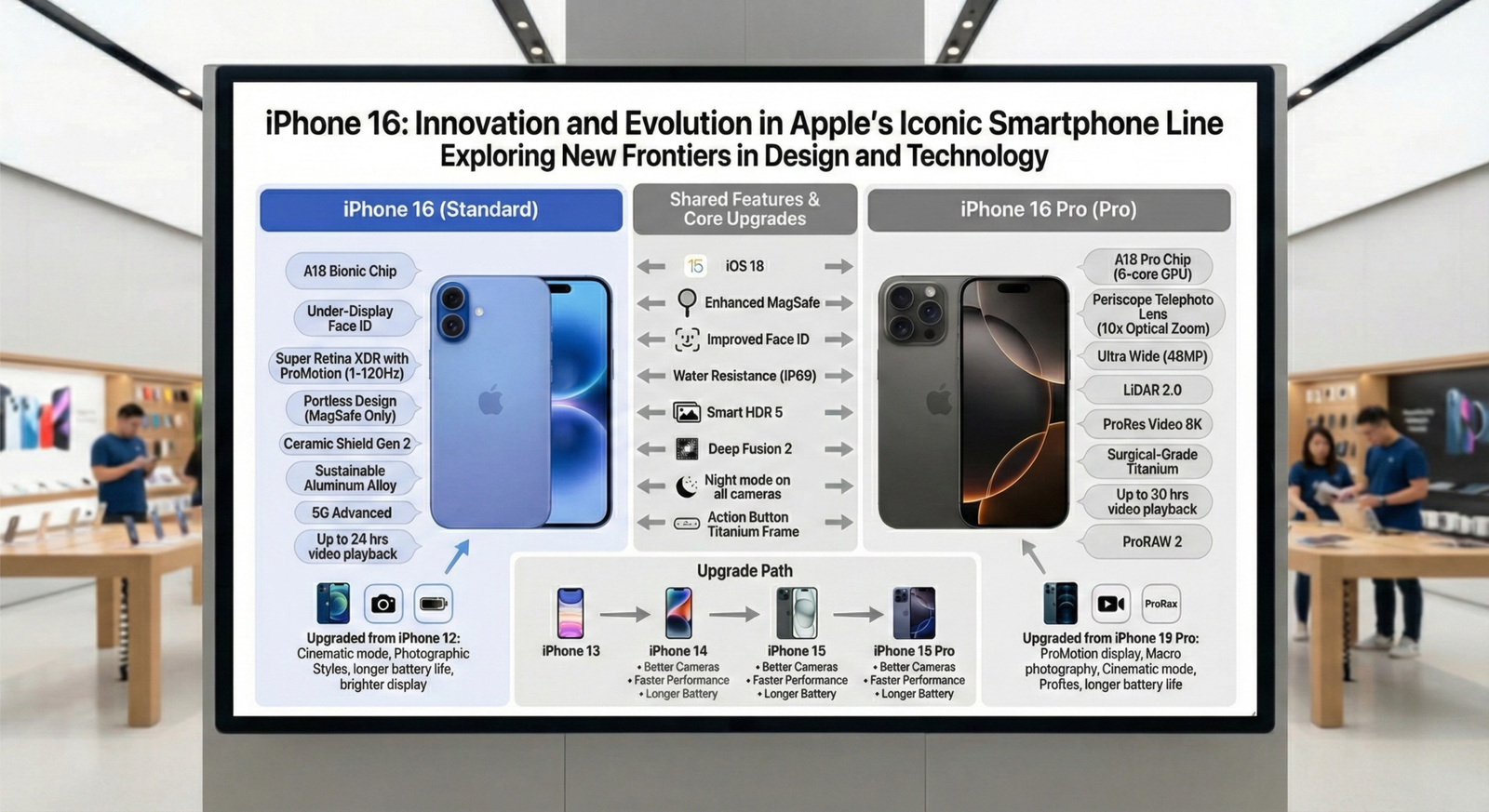
The iPhone 16 marks a definitive evolution in Apple’s smartphone lineage, raising the bar for performance, efficiency, and everyday utility. Channeling the design language that has come to define recent generations, the iPhone 16 is distinguished by subtle refinements: a slightly thinner profile, softened corner radii, and aerospace-grade matte aluminum edges with a more tactile finish. Apple’s renewed attention to aesthetics shines through in the expanded palette, offering serene tones like Arctic Blue, Rose Quartz, and Midnight – each crafted with a durable, color-infused glass back that resists both fingerprints and microabrasions.
Underneath these design refinements lies the all-new Apple A18 chip, engineered with a second-generation 3-nanometer process. This silicon leap brings major boosts to CPU and GPU performance, but more impressively, an AI-optimized Neural Engine accelerates on-device intelligence, powering everything from next-level photo editing to contextual Siri interactions. Complementing this raw power is the iPhone 16’s superior thermal architecture. An innovative vapor chamber cooling system keeps temperatures stable during intensive tasks or extended gaming sessions, ensuring faster sustained performance with less throttling—a critical advantage for power users and creatives alike.
Apple has also put considerable emphasis on connectivity and visual experience. The iPhone 16 arrives Wi-Fi 7 ready, unlocking multi-gigabit speeds, dramatically lower latency, and robust network stability for demanding applications such as AR streaming and multiplayer gaming. Its Super Retina XDR display is brighter and more energy-efficient than ever before, featuring micro-lens array technology for improved outdoor viewing and true-to-life color accuracy. Even bezels have been minimized, immersing users further in content. These upgrades, paired with longer battery life, reinforce the iPhone 16’s commitment to real-world improvements—devices that feel not just faster, but smarter and more engaging at every interaction.
Camera Innovations and Creative Possibilities
The iPhone 16’s camera system represents a significant leap in Apple’s continuous quest to empower users with professional-grade imaging tools. At its core is the new dual-lens, vertically-aligned array: a 48MP wide lens and a 12MP ultrawide lens. This configuration isn’t just about higher pixel counts; it’s about the new fusion camera technology that meaningfully melds data from both lenses in real time. The result is richer detail, more accurate color rendering, and superior dynamic range across all shooting conditions—from harsh midday sun to low-lit interiors.
Spatial video capture is perhaps the most transformative addition. By utilizing both lenses simultaneously, the iPhone 16 enables users to record immersive three-dimensional videos, setting the stage for an entirely new category of content perfect for Apple’s expanding ecosystem, including mixed reality. This forward-looking capability makes creative storytelling more intuitive and accessible than ever before.
Enhanced photographic styles go beyond simple color filters. Leveraging the power of advanced machine learning, users can customize the aesthetic of their photos at the point of capture, with the camera intelligently adjusting tone and warmth while maintaining true-to-life skin tones and nuanced scene elements. This delivers a tailored, yet authentic, photographic experience.
A particularly notable refinement is the new Camera Control button, a physical button dedicated to camera operations. With its tactile feedback and customizable shortcuts—such as instant video mode or direct macro access—users gain unprecedented control over spontaneous and complex shooting scenarios.
Working in concert, these innovations extend the creative frontier for mobile photography and videography. They allow casual users and professionals alike to achieve new levels of storytelling, capturing moments with speed, precision, and artistry that rival even dedicated camera equipment—all from the compact form factor of the iPhone 16.
Performance, Connectivity, and User Interaction
Driven by the all-new Apple A18 chip, the iPhone 16 redefines what performance means for a modern smartphone, particularly in how seamlessly it handles demanding and intelligent workloads. The A18’s custom architecture is specifically tuned for the AI-first era, amplifying both raw computing power and efficiency through an advanced Neural Engine with even more dedicated AI cores. This design isn’t just about raw benchmarks—it makes day-to-day experiences tangibly richer. App launch times have shrunk to near-instantaneous, and the Neural Engine’s increased speed facilitates real-time processing for features like on-device language translation, content creation, and more complex Siri interactions.
Gamers and creators benefit most from this muscle. Console-quality games leverage the A18’s optimized GPU and expanded RAM, delivering richer graphics without frame drops or heat issues, while creative apps for photo editing and 3D modeling access hardware-accelerated AI for effects and rendering pipelines. Multitasking also feels transformed by the chip’s architecture: power users can shift between resource-hungry applications with little to no lag, and background processes like uploading spatial videos or transcribing calls continue smoothly.
On the connectivity front, the leap to Wi-Fi 7 offers unprecedented wireless bandwidth and ultra-low-latency, supporting both home streaming setups and professional tasks in collaborative, connected environments. Enhanced SIM options—such as expanded global eSIM support—maximize freedom for international users and simplify switching carriers.
Usability upgrades enhance everyday interaction. The customizable Action button now integrates deep system-level functions, letting users assign shortcuts not only for utility tasks but also personalized automations. The iOS interface refines haptics, gestures, and accessibility, creating a more inclusive experience whether adjusting display sizes or controlling the device via voice. Collectively, these advances underscore Apple’s ongoing push to intertwine raw performance, intuitive design, and everyday connectivity into a cohesive user experience.
The iPhone 16 in the Context of Apple’s Vision
Apple’s journey with the iPhone has always been one of iterative reinvention, and the iPhone 16 continues to advance the company’s vision in ways that go beyond just hardware and performance. In line with Apple’s storied tradition, the iPhone 16 is designed to embody the philosophy of merging cutting-edge technology with a deep sense of humanity and responsibility. Environmental stewardship, for instance, is more than a feature—it’s integral to the device’s identity. By removing items such as promotional stickers from the box and further minimizing packaging, Apple signals a shift toward reducing unnecessary waste, reinforcing a larger push for sustainability that can set trends across the industry.
More than a single product, the iPhone 16 is crafted as a seamless node within the ever-expanding Apple ecosystem. Features like cross-device continuity, AirDrop, and tight integration with Apple Vision Pro and the latest iPads create a symbiotic environment, inviting users to experience digital life as a fluid continuum rather than through isolated gadgets. For developers, every iPhone generation—particularly one as forward-thinking as the 16—becomes a fresh canvas for reimagining what’s possible with apps, APIs, and services that tap into Apple’s new frameworks and expanded capabilities.
Consumers gain more than just incremental upgrades; they find themselves at the forefront of a shift toward more mindful technology, where privacy, environmental ethics, and device longevity have tangible priority. The ripple effect reaches the broader mobile sector: rival manufacturers and service providers are prompted to evolve, adopting standards and values initiated by Apple. In this way, the iPhone 16 is as much a harbinger of systemic industry evolution as it is a personal device, hinting at the ever-growing role technology will play in both shaping our routines and our responsibilities for the future.
Conclusions
The iPhone 16 strengthens Apple’s position at the forefront of smartphone innovation. With significant boosts to design, camera, performance, and user experience, it both honors the iPhone’s influential heritage and steers the device into a new era. By examining its evolution and the latest advancements, we see how Apple continues to inspire loyalty and shape the future of mobile technology.
Welcome! For more in‑depth product and tech reviews, visit homepaw shub .
 Email Submit Button: “Get Free Guide Now”
[…] how these assistants compare to Apple’s evolution? See our iPhone 16 future guide or look back at the iPhone 14’s evolution for lessons on ecosystem lock-in and […]