

Table of Contents
The iPhone 13 series marks a significant milestone in Apple’s evolution of smartphones, blending refined design, advanced hardware, and innovative features. In this article, we dive deep into the iPhone 13 and iPhone 13 Pro, uncovering what sets them apart, the improvements over previous models, and why they have captured the attention of Apple enthusiasts worldwide.
The Evolution and Legacy of the iPhone
The iPhone redefined what a mobile phone could be when it launched in 2007, setting off a transformative era in technology and user interaction. Apple’s decision to merge a phone, an iPod, and an internet communicator in a single device was revolutionary. The original iPhone was also the first to introduce a capacitive multi-touch screen, eliminating the need for physical keyboards or styluses and laying the foundation for intuitive gesture-based navigation. This design philosophy put usability at the core and soon became the standard for all smartphones.
One of the most significant evolutionary leaps came with the App Store in 2008. This platform exploded the iPhone’s capabilities, bringing millions of applications that spurred an entirely new ecosystem for developers and consumers alike. Each iPhone generation since has layered in major innovations: improved cameras, better displays, and faster processors, consistently pushing the envelope for what a smartphone can do.
Security and convenience were continually reimagined. Touch ID, introduced with the iPhone 5s, revolutionized device security using fingerprint recognition, and then Face ID, starting with the iPhone X, elevated biometric verification to a new level using advanced facial mapping. The removal of the physical Home button streamlined design and increased screen real estate.
Yearly hardware and software updates have ensured the iPhone remains at the cutting edge. Apple’s dedication to seamless hardware-software integration unlocks features that maximize performance and battery efficiency, while regular iOS updates keep older models relevant longer. Through consistent innovation in both design—sleeker bodies, durable materials, vibrant colors—and user experience, the iPhone has set the benchmark in mobile technology. Its evolution culminates in the iPhone 13 series, carrying forward this legacy and expanding the roadmap for what users can expect from a phone in terms of intelligence, connectivity, and everyday utility.
What Sets the iPhone 13 Series Apart
The iPhone 13 series introduced a refined vision of what the modern smartphone could be, bringing subtle but meaningful upgrades over its predecessors. The most visually noticeable change came with the introduction of a smaller notch, reducing its width by about 20% compared to the iPhone 12 lineup. This less intrusive notch made for a more immersive viewing experience, while retaining all Face ID functionality. Both iPhone 13 and 13 Pro also adopted new, flatter-edged designs, echoing the aesthetic elegance of earlier iPhones with a contemporary twist.
The array of color options further sets the iPhone 13 series apart. The base models appeared in playful choices like Pink and Blue, while the Pro models stood out with sophisticated finishes such as Sierra Blue and Graphite, giving users more ways to express personal style through their device. The rear camera housing on the iPhone 13 was also rearranged to a diagonal layout—both a design and functional update.
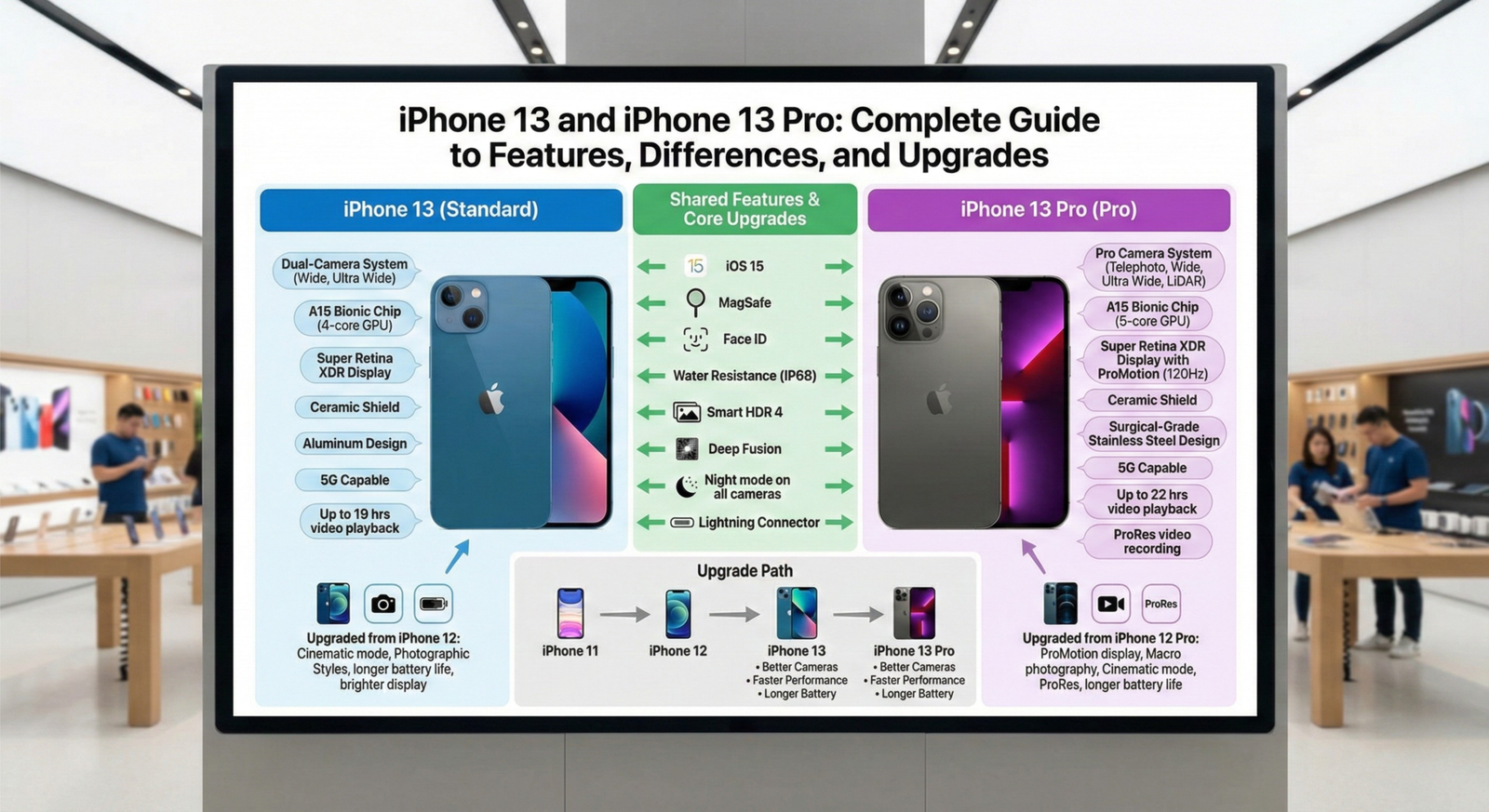
Durability saw notable improvement. The iPhone 13 and 13 Pro feature a “Ceramic Shield” front cover, reportedly tougher than any other smartphone glass, and an improved water resistance rating, making accidental drops and spills less concerning.
Under the hood, the leap to the A15 Bionic chip delivered a substantial performance boost. This chip supports faster processing, improved energy efficiency, and advanced AI tasks, all while ensuring smoother day-to-day operations and longer battery life. The iPhone 13 series achieved up to 2.5 more hours of battery life over previous models, a vital upgrade for heavy users. Combined with these technical enhancements, the iPhone 13 Pro brought a new level of photographic capability and display technology, previewing the power of ProMotion and higher brightness, which will be explored further in the next section.
Display and Performance: ProMotion and Processing Power
The iPhone 13 and iPhone 13 Pro lineups both offer stunning OLED displays, but the distinctions between them significantly impact user experience. Both the standard iPhone 13 and iPhone 13 Pro feature a 6.1-inch Super Retina XDR display, while their smaller counterparts—the iPhone 13 mini and iPhone 13 Pro—share a 5.4-inch option. However, the iPhone 13 Pro’s screen is a leap ahead in key areas. Both reach up to 800 nits typical brightness, with the Pro models boosting this to an exceptional 1,000 nits, enhancing visibility in bright sunlight and supporting a better HDR experience.
A defining advantage of the Pro models is the inclusion of ProMotion technology, enabling an adaptive refresh rate up to 120Hz. This means that animations, scrolling, and touch interactions appear dramatically smoother and more responsive. The system intelligently scales down to 10Hz for static content, preserving battery while delivering silky motion during gaming, video, and even simple web browsing. For users, this translates into an immediate sense of fluidity—a difference particularly appreciated by gamers, creative professionals, or anyone who values a premium touch experience.
Both iPhone 13 and 13 Pro are powered by the impressive A15 Bionic chip, which integrates a 6-core CPU and a next-generation 16-core Neural Engine for lightning-fast machine learning. The Pro models, however, possess a 5-core GPU, a step up from the 4-core GPU in the standard iPhone 13. This separates the Pro’s performance ceiling, offering striking gains in intensive tasks like video editing, 3D rendering, and the latest games. In day-to-day multitasking—switching between demanding apps or editing multiple 4K videos—the Pro’s advantage is felt in seamless transitions and zero lag, cementing its place as the performance king of the lineup.
Cameras and Computational Photography
When comparing the camera systems of the iPhone 13 and iPhone 13 Pro, Apple continues to distinguish its Pro models through cutting-edge hardware and intelligent computational photography. Both devices feature impressive dual or triple camera arrays, but the Pro’s expanded hardware sets new standards for mobile imaging.
The iPhone 13 offers a dual 12MP camera system, consisting of wide and ultra-wide lenses. These sensors are larger than in previous generations, allowing more light and improving detail in low-light scenarios. Sensor-shift optical image stabilization, borrowed from last year’s Pro Max, now appears on both models, ensuring steady handheld shots. The ultra-wide lens also gains a wider aperture, resulting in better night photography.
The iPhone 13 Pro raises the stakes with a triple-lens setup: wide, ultra-wide, and a 3x telephoto lens, all 12MP. The Pro’s ultra-wide lens supports macro photography, letting users focus on subjects just 2cm away. Night mode is available on all three rear cameras and the front-facing TrueDepth camera—another Pro advantage, enabling more versatile low-light shooting.
Apple fuels these hardware upgrades with its renowned computational photography features. Both phones benefit from Smart HDR 4, Deep Fusion, and photographic styles, allowing users to personalize tone and warmth without sacrificing skin tones. However, the iPhone 13 Pro uniquely offers Apple ProRAW for photographers seeking maximum creative flexibility, and ProRes video recording—a professional-grade codec—on select storage options.
Cinematic Mode is a highlight across both models, offering rack focus and real-time depth changes in video for a dramatic, professional look. This is enhanced on the Pro with its LiDAR scanner for faster, more accurate focus, especially under challenging conditions.
These imaging advancements, particularly on the Pro, cement the iPhone’s reputation for pushing boundaries in smartphone photography and videography, catering to both casual users and creative professionals alike.
Choosing Between iPhone 13 and iPhone 13 Pro
Choosing between the iPhone 13 and iPhone 13 Pro depends on an interplay of priorities such as budget, performance expectations, daily use habits, and desired longevity. The price gap is significant—while the iPhone 13 delivers much of what makes the 13 Pro great, the Pro line justifies its extra cost with advanced features aimed at enthusiasts and professionals.
For many, the core performance difference is less pronounced; both models are powered by the A15 Bionic chip, ensuring silky smooth operation, but the Pro model carries an extra GPU core for more demanding graphics tasks. This edge is notable in gaming and intensive apps, but for casual users, the standard iPhone 13 rarely feels underpowered.
Display preferences shape the experience even more profoundly. The iPhone 13 Pro boasts a ProMotion 120Hz adaptive refresh rate, yielding a fluidity in scrolling and system animations that once experienced is hard to forget, particularly for those who game often or value the most responsive touchscreen interaction. If media consumption and general use lean toward streaming, social media, and web browsing, the standard Super Retina XDR display of the iPhone 13 still dazzles with color accuracy and brightness.
For users prioritizing longevity, the Pro also benefits from a slightly more robust build—stainless steel edges versus aluminum—and increased RAM, helping future-proof it for several years of iOS updates and demanding apps. Ultimately, enthusiasts, heavy multitaskers, and those with photography or professional aspirations will draw the most value from the Pro’s bonuses; everyday users who seek reliable performance, excellent battery life, and a premium display at a better price will find the iPhone 13 fully sufficient for every scenario outside the most specialized needs.
Conclusions
In summary, the iPhone 13 series offers significant improvements in design, power, and photography over previous generations. The iPhone 13 Pro stands out with its ProMotion display and advanced camera features, appealing to power users and creatives, while the iPhone 13 delivers outstanding value and performance for everyday users. Choosing between them depends on your priorities and how you use your smartphone.
Welcome! For more in‑depth product and tech reviews, visit homepaw shub .
 Email Submit Button: “Get Free Guide Now”